

Customer Data Platforms and Consent: How CDPs Should Work With Your CMP
July 9, 2026
•

8 min read
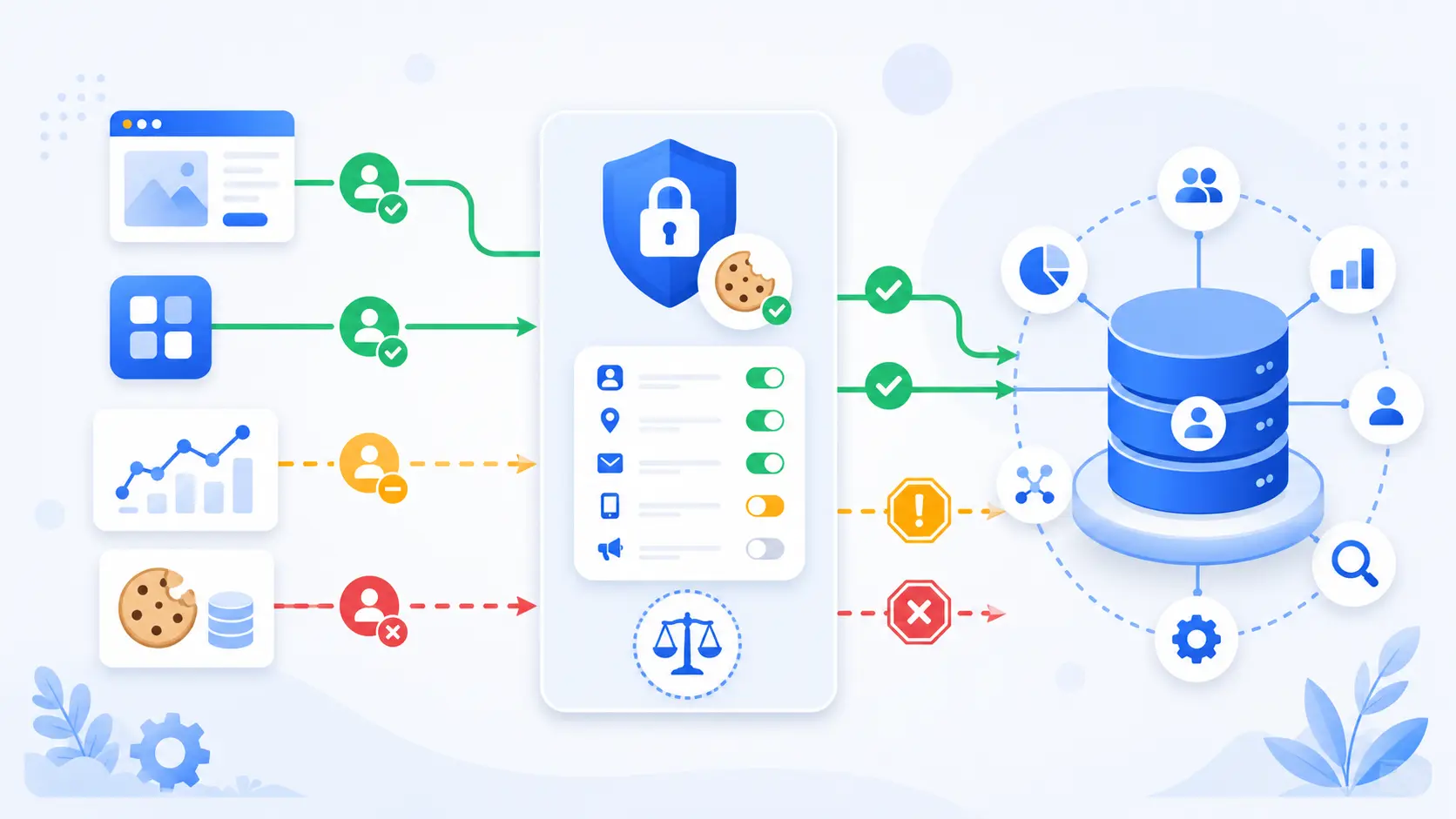
Table of contents
back
to the top
Customer Data Platforms and Consent: How CDPs Should Work With Your CMP
Customer Data Platforms, or CDPs, are built to bring customer data together. They can collect information from websites, apps, CRMs, email tools, ecommerce systems, advertising platforms, support tools, and offline sources.
That makes them powerful, but risky if consent is not handled properly.
A CDP can help a business understand users across channels, build segments, personalise journeys, measure campaigns, and activate data in other tools. But if it receives data before consent, keeps data after consent is withdrawn, or sends data to advertising platforms without permission, the marketing stack can become a compliance problem.
That is why your CDP should work directly with your Consent Management Platform, or CMP.
A CMP collects and stores the user's consent choice. A CDP should respect that choice before collecting, joining, storing, or activating customer data.
What is a CDP?
A Customer Data Platform is software that helps companies collect and organise customer data from multiple sources.
A CDP may process data such as:
- Website events
- App events
- Email engagement
- Purchases
- Form submissions
- CRM records
- Support tickets
- User IDs
- Device identifiers
- Marketing campaign data
- Subscription status
- Customer preferences
- Consent status
The purpose is usually to create a clearer view of the customer and make that data usable across marketing, analytics, sales, and product tools. The privacy question is whether the CDP is collecting and sharing data in line with the user's choices.
Why consent matters for CDPs
CDPs sit close to the centre of a company's data stack. If consent is wrong at the CDP level, the same mistake can spread into analytics reports, ad audiences, email segments, personalisation engines, CRM enrichment, data warehouses, and support tools.
This is why consent should not only control the cookie banner. It should control the data flow.
The European Data Protection Board's Guidelines 05/2020 on consent explain that valid consent under GDPR must be freely given, specific, informed, and unambiguous. If your CDP uses data for different purposes, those purposes need to be reflected clearly in your consent setup.
A user may agree to analytics but reject marketing. Your CDP should understand and enforce that difference.
CMP vs CDP: what each system should do
A CMP and a CDP are not the same thing.
What the CMP should do
A CMP should show the banner, explain tracking purposes, let users accept or reject cookies, store consent records, block non-essential scripts before consent, allow users to change choices, and send consent signals to other tools.
CookiePal's consent management page explains features such as cookie auto-blocking, cookie scanning, and consent banners.
What the CDP should do
A CDP should receive consent status from the CMP, store it against the user or profile, use it to decide what data can be collected, suppress users from audiences when consent is missing, and stop activation when consent is withdrawn.
In simple terms: the CMP captures permission. The CDP enforces it across customer data.
The biggest mistake: treating consent as a banner-only issue
Many businesses install a cookie banner, then continue sending all website events into the CDP as usual.
That is a problem.
If the CDP receives event data before consent is granted, the business may already be processing data that should not have been collected. Consent should be checked before data enters the CDP, not only after collection.
For example:
| Consent state | CDP behaviour |
|---|---|
| No choice yet | Collect only strictly necessary events |
| Reject analytics | Do not collect analytics events |
| Reject marketing | Do not send data to ad platforms |
| Accept analytics | Allow analytics events |
| Accept marketing | Allow marketing activation |
| Withdraw consent | Stop relevant processing and update destinations |
How consent should flow from CMP to CDP
A strong setup usually works like this: the CMP loads before non-essential tracking, the user makes a choice, the CMP stores that choice, the CDP receives the consent status, and the CDP uses it to allow or block data collection and activation.
This helps avoid a common privacy gap: the banner says one thing, but the marketing stack does another.
If your website uses Google tags, your CMP may also need to work with Google Consent Mode. Google explains how websites can send consent states to Google tags here: Set up consent mode on websites.
What consent categories should map to CDP purposes?
Your CDP should not treat all consent as one general yes or no.
Most businesses need purpose-based consent categories.
Core categories usually include strictly necessary, preferences, analytics, marketing, and personalisation. These categories should be reflected in the CDP's event rules and destination rules.
A user who accepts analytics but rejects marketing may still appear in aggregated analytics reports, but should not be added to a retargeting audience.
CDP destinations need consent rules too
A CDP is often connected to many destinations, such as Google Ads, Meta Ads, LinkedIn Ads, email platforms, CRM tools, data warehouses, product analytics tools, support tools, and personalisation engines.
Each destination should have rules based on consent.
For example, send analytics events only when analytics consent is granted, send ad audiences only when marketing consent is granted, avoid unnecessary fields, and suppress users when consent is withdrawn.
A CDP should not be a pipe that sends everything everywhere. It should be a controlled routing layer.
Contracts and vendor roles
CDPs often process personal data on behalf of the business. In many cases, that means the CDP vendor acts as a processor, while the business acts as the controller.
The ICO's guidance on contracts between controllers and processors explains that when a controller uses a processor to process personal data on its behalf, a written contract needs to be in place.
For CDPs, this matters because the vendor may handle large volumes of customer data and may use sub-processors for hosting, enrichment, support, analytics, or delivery.
Before connecting a CDP, check who is the controller, who is the processor, whether there is a data processing agreement, which sub-processors are used, where data is stored, and what happens when consent is withdrawn.
Data minimisation and CDPs
CDPs can collect a lot of data. That does not mean they should.
Data minimisation means collecting only what is necessary for a defined purpose. For CDPs, this means avoiding every possible event, field, and identifier "just in case."
Before sending data to the CDP, ask whether the event, field, or identifier is needed, linked to a clear purpose, explained to users, covered by consent where needed, and kept only for a reasonable period.
A smaller, cleaner CDP setup is easier to govern and easier to explain.
Practical CMP and CDP checklist
Before your CMP and CDP go live together, check:
- The CMP loads before non-essential CDP tracking
- Consent categories are mapped to CDP purposes
- The CDP receives and stores consent status
- Events are blocked when consent is missing
- Marketing destinations are blocked when marketing consent is rejected
- Consent withdrawal updates the CDP and destinations
- Consent logs are stored
- The privacy policy explains CDP data use
- Vendor contracts and sub-processors are reviewed
- Unnecessary events and fields are removed
CookiePal's features page highlights cookie auto-blocking, scheduled scanning, auto-categorisation, Google Consent Mode v2, and multilingual banners, which can help manage consent before data reaches tools like a CDP.
Where CookiePal fits
A CDP helps businesses use customer data. A CMP helps make sure that data is collected and used with proper user choice.
With CookiePal, businesses can manage cookie consent, scan for cookies, block non-essential tracking, support Google Consent Mode v2, and give users clearer control over their preferences. You can review plan options on the CookiePal pricing page.
Conclusion
A CDP should not work around consent. It should work with consent.
If your CMP collects user preferences but your CDP ignores them, the consent banner is only doing part of the job. The real test is whether those choices control what data is collected, how profiles are built, and where customer data is sent.
The best setup is simple in principle: collect consent through the CMP, pass it into the CDP, enforce it across events and destinations, and update it when users change their minds.
A CDP can make customer data more useful. A CMP helps make sure that usefulness does not come at the cost of user trust.
Explore further

Shopify Customer Events, Pixels and Cookie Consent
Shopify pixels still collect and send customer data, so they still need consent. Learn how app pixels, custom pixels and the Customer Privacy API should work with your CMP.
October 8, 2026
7 min
WordPress Cookie Consent: Which Plugins and Scripts Need Blocking?
A WordPress banner is not enough if plugins load trackers before consent. Learn which analytics, ad, chat and embed scripts need blocking and how to audit your full stack.
October 8, 2026
7 min
Klaviyo, Shopify and Consent: What E-Commerce Stores Need to Check
Shopify and Klaviyo can track and contact customers in ways they never agreed to. Learn how to align cookie, email and SMS consent across checkout, forms, flows and data sync.
October 1, 2026
7 min