

CMP Myths Busted, Part 1: “All You Need Is a Cookie Banner”
December 12, 2025
•

3 min read
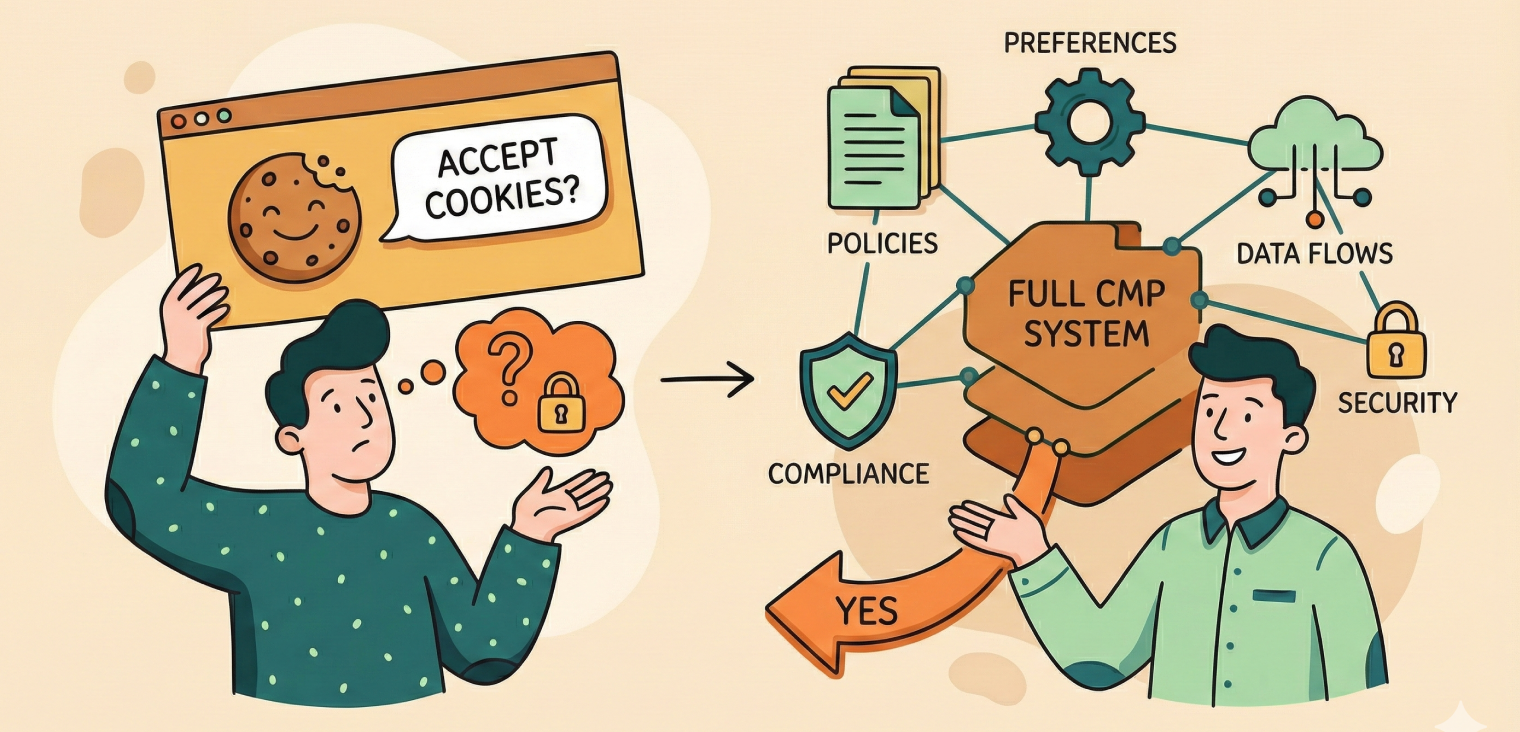
Table of contents
back
to the top
CMP Myths Busted, Part 1: “All You Need Is a Cookie Banner”
One of the most common misconceptions in GDPR compliance is the idea that simply adding a cookie banner to your website is enough. Spoiler alert: it’s not.
In this first installment of our CMP Myths Busted series, we’re breaking down why this oversimplification can lead to major compliance gaps, loss of user trust, and even regulatory fines.
The Myth: “We have a cookie banner, we’re compliant.”
It’s a statement heard often from marketing teams, developers, or legal departments juggling multiple priorities. But relying on just a banner without a full consent management solution misses the point of the General Data Protection Regulation (GDPR).
A banner alone doesn’t make your data processing lawful. Consent has to be informed, freely given, granular, and recorded.
The Reality: A Cookie Banner ≠ GDPR Compliance
Here’s what a cookie banner typically does not do:
“Cookie Banner Only” vs. “Full CMP”
A cookie banner on its own lacks the functionality required for true GDPR compliance. Here’s how it compares to a full Consent Management Platform:
-
A cookie banner only shows a pop-up, often without real choices.
A full CMP provides clear, granular consent options that let users control specific categories like analytics, marketing, or personalization. -
A cookie banner typically does not log or store proof of consent, meaning you cannot demonstrate compliance during an audit.
A full CMP stores detailed consent records, making your data processing defensible to regulators. -
A banner usually applies the same settings to every user, regardless of location.
A CMP uses geo-targeting, applying the right standards for GDPR, UK GDPR, or regions that don’t require consent. -
A simple banner doesn’t delay scripts, which means cookies and pixels may still fire before consent is given.
A CMP blocks tracking scripts until valid consent is received. -
Some banners automatically load cookies, no matter what users choose.
A CMP ensures proper compliance by controlling tag firing based on user decisions. -
A basic banner lacks lifecycle management, meaning it doesn’t handle consent expiration, updates, or re-prompts.
A CMP manages the full consent lifecycle, including refresh intervals, policy changes, and vendor updates.
What GDPR Actually Requires
To be compliant, your consent management approach needs to meet specific requirements, including:
-
Prior consent before setting non-essential cookies
-
Granular options (e.g., analytics vs. marketing cookies)
-
Ability to refuse cookies as easily as accept
-
Transparent purposes and third parties
-
Proof of consent for audits
-
Withdrawal at any time
All of this falls outside what a simple banner can do.
Why a CMP Is the Real Solution
A Consent Management Platform (CMP) goes beyond the front-end banner:
-
It integrates with your tag manager (e.g., GTM) to delay firing until consent is given.
-
It provides a user interface that reflects GDPR’s requirements — clear options, no dark patterns.
-
It manages geo-based logic, offering different behaviors based on location (e.g., GDPR vs. rest of world).
-
It stores and logs consent in a legally defensible way.
-
It allows you to re-request consent when settings change or new vendors are added.
Real-World Risk of “Just a Banner”
In 2023, multiple companies were fined across the EU for:
-
Automatically dropping cookies before consent
-
Failing to provide a reject option
-
Misleading users with vague consent language
-
No ability to prove consent records
Each case had one thing in common: they treated the banner as a checkbox, not a system.
Final Takeaway
If your compliance strategy starts and ends with “just slap on a cookie banner,” it’s time to rethink.
True GDPR compliance means:
-
Offering real choices
-
Blocking tracking until consent
-
Storing valid logs
-
Respecting user rights throughout the lifecycle
That’s why companies serious about compliance and UX turn to CMPs not shortcuts.
Sources
GDPR Article 7 - Conditions for Consent EDPB Guidelines 05/2020 on Consent CNIL Cookie Consent Sanctions (2023)
Explore further

What Happens to Your Ad Campaigns When Consent Mode Is Set Up Wrong
See how an incorrect Google Consent Mode setup can underreport conversions, shrink remarketing audiences, and send campaign optimisation in the wrong direction.
July 30, 2026
8 min

Cookie Consent for Mobile Web vs Desktop: Should the Banner Be Different?
Learn how to design a responsive cookie consent banner for mobile and desktop visitors.
July 23, 2026
8 min

Zero-Party Data vs First-Party Data: What Marketers Need to Know About Consent
Learn the practical difference between zero-party and first-party data, and why both still require clear purposes, transparency, and valid consent.
July 16, 2026
8 min