

Consent Management for AI Chatbots
June 17, 2026
•

4 min read
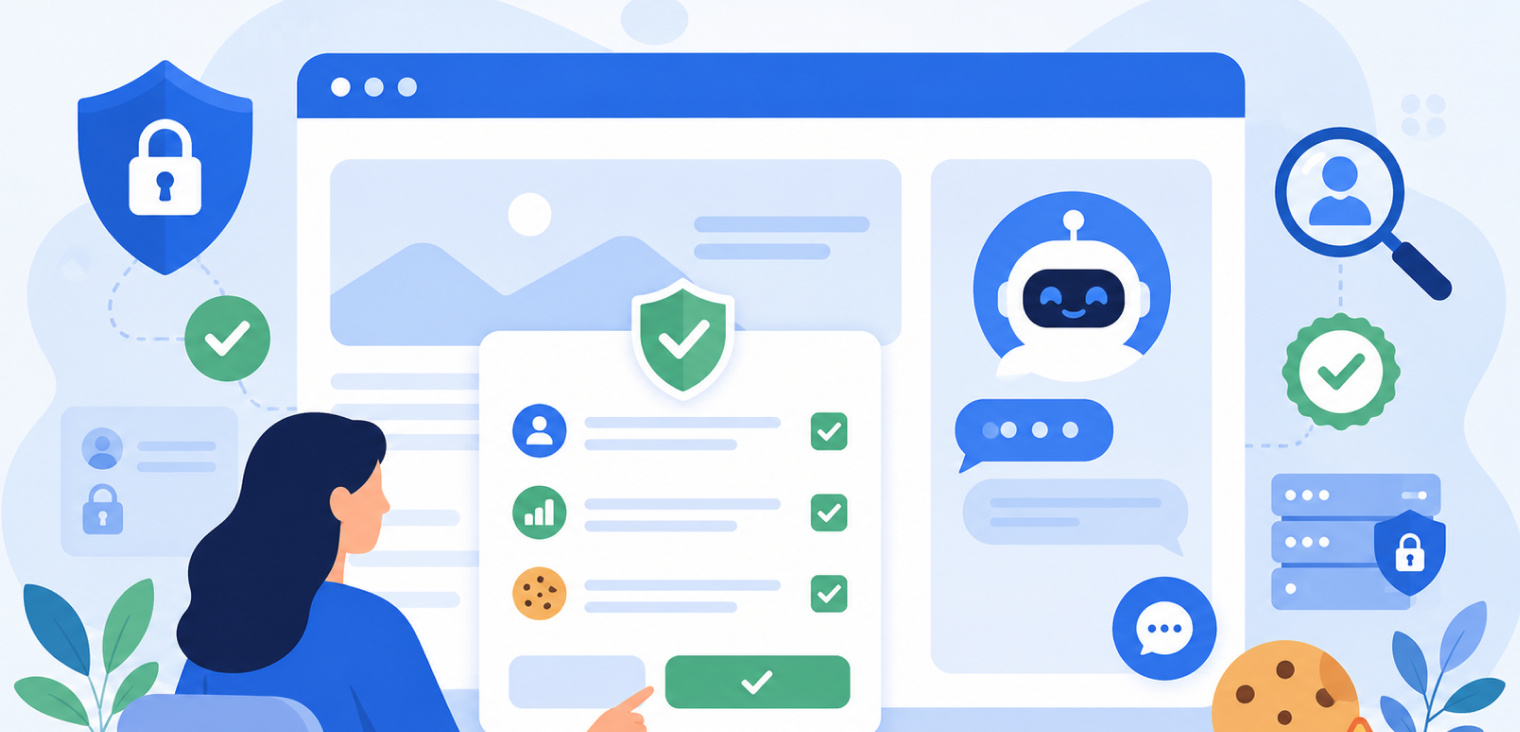
Table of contents
back
to the top
Consent Management for AI Chatbots: What Websites Need to Disclose in 2026
AI chatbots are now a normal part of many websites. They answer support questions, recommend products, qualify leads, collect contact details, book calls, and help visitors find the right page faster. For businesses, they can reduce pressure on support teams and improve conversion. For users, they can make a website feel easier to use.
But an AI chatbot is not just a design feature. It can collect and process personal data. It may also load scripts, use browser storage, connect with analytics tools, send information to a CRM, or store conversation history. That means chatbot privacy needs to be handled with the same care as cookie consent, tracking pixels, and website analytics.
In 2026, website owners should not treat AI chatbots as separate from consent management. If a chatbot collects data, stores identifiers, uses tracking technologies, or shares information with third-party platforms, users need clear information and, in some cases, a real consent choice.
1. Why AI Chatbots Create Privacy Risk
A basic contact form is usually easy to understand. A visitor enters their name, email, and message. The website sends that information to the business. A chatbot can be more complex.
Depending on the setup, an AI chatbot may process:
- Chat messages
- Names and email addresses
- Phone numbers
- Company names
- Account or order details
- Product preferences
- Support history
- IP addresses
- Device and browser information
- Page activity before or during the chat
- Conversation timestamps
- Unique user or session IDs
Some of this data is clearly personal. Some of it may become personal when linked with other information. The UK Information Commissioner's Office (ICO) explains that organisations using AI still need to follow data protection principles, including transparency, fairness, accountability, security, and data minimisation. You can read the ICO's official guidance here: AI and data protection guidance.
The main issue is that users may not realise how much is happening behind a small chat window. They might think they are asking a quick product question, while the website is also storing the conversation, syncing it to a CRM, analysing intent, or using it to improve future responses.
That does not mean AI chatbots should be avoided. It means they should be explained properly.
2. Does an AI Chatbot Need Cookie Consent?
Sometimes yes. It depends on what the chatbot does technically.
Cookie consent may be needed if the chatbot stores or accesses information on the user's device and that activity is not strictly necessary. This includes cookies, local storage, tracking identifiers, session IDs, and similar technologies.
The ICO's guidance on cookies and similar technologies makes it clear that the rules are not limited to traditional cookies. Similar technologies can also fall within the same consent requirements.
For example, consent may be needed if the chatbot uses:
- Analytics tracking
- Marketing pixels
- Cross-site tracking
- Behavioural profiling
- Persistent user identifiers
- Session replay
- Advertising integrations
- CRM tracking scripts
- Third-party storage that is not essential
A simple chatbot that only provides basic support during the current visit may have a different privacy profile from an AI chatbot connected to advertising, analytics, lead scoring, and retargeting.
The safest approach is to audit the chatbot as part of your wider website tracking setup. Do not rely only on the vendor's description. Check what loads, when it loads, what data is collected, and where that data goes.
3. What Your Website Should Disclose
Users should be able to understand what happens when they interact with your chatbot. The explanation should be clear enough for a normal visitor, not only for a lawyer or developer.
Who provides the chatbot
Tell users whether the chatbot is operated by your own business, a third-party provider, or both. If a third-party provider processes chat data, this should be reflected in your privacy policy.
What data is collected
Avoid vague wording like "we may collect information to improve our services." Be more specific. Depending on your setup, your privacy notice could explain that the chatbot may collect message content, contact details, technical data, page interaction data, and timestamps.
Why the data is used
Purpose matters. A chatbot used for customer support is different from a chatbot used for sales profiling. Common purposes include responding to support questions, routing enquiries, booking demos, improving website experience, and following up with sales enquiries.
If the chatbot data is used for marketing, remarketing, profiling, lead scoring, or AI model improvement, that should be explained clearly.
Whether conversations are used to train AI
This is one of the biggest chatbot privacy questions. Some AI tools may use user conversations to improve their systems. Others allow customers to disable training. Website owners should check this carefully. If conversations can be used for model training or product improvement, your privacy notice should say so.
Which third parties receive the data
Many chatbot tools connect with CRM platforms, email marketing systems, helpdesk tools, analytics platforms, and advertising platforms. That data flow needs to be understood before you can write an accurate privacy notice or configure consent correctly.
How long chat data is kept
Retention is often forgotten. A better approach is to define retention periods based on purpose. The GDPR principle of storage limitation means personal data should not be kept longer than necessary. The European Data Protection Board provides official guidance here: Guidelines 05/2020 on consent.
4. Where to Explain Chatbot Privacy
A good chatbot privacy setup usually appears in more than one place.
Cookie banner or consent panel
If the chatbot uses non-essential tracking, it should be controlled through your cookie banner or consent panel. Analytics and marketing scripts connected to the chatbot should not load before the user gives the relevant consent.
Chatbot opening message
The chatbot itself can include a short notice before the user starts typing. For example:
"Please do not share sensitive information in this chat. We use your message to respond to your enquiry and may store the conversation according to our Privacy Policy."
Keep it short. The goal is not to scare users — the goal is to set expectations.
Privacy policy and cookie policy
Your privacy policy should contain the fuller explanation, covering categories of data collected, purposes, legal basis, vendors, retention periods, and user rights. If the chatbot uses cookies or similar technologies, your cookie policy should also reflect that.
5. How a CMP Can Support Chatbot Compliance
A CMP cannot make every chatbot compliant by itself. It cannot fix vague vendor contracts, poor retention settings, or unclear AI training terms. But it can help with the consent and transparency layer.
A CMP can help you:
- Scan for cookies and tracking technologies
- Categorise chatbot-related cookies
- Block non-essential scripts before consent
- Store consent records
- Let users change preferences
- Support regional consent rules
- Connect consent choices with analytics and marketing tools
This matters because chatbots are often added quickly by marketing, sales, or support teams. A regular cookie scan can help catch new scripts and trackers before they become a hidden compliance issue.
6. Common AI Chatbot Consent Mistakes
Loading the chatbot too early
If a chatbot sets analytics or marketing cookies before the user gives consent, the consent banner may not be doing its job. Test the site before consent, after reject, and after accept.
Forgetting chatbot integrations
The chatbot might be only one part of the data flow. Check the connected CRM, helpdesk, email platform, analytics tags, and ad platforms.
Using unclear privacy wording
Users should know what happens to their messages. Avoid generic wording that hides the real activity.
Keeping transcripts for too long
If chat transcripts are no longer needed, delete them according to a defined retention policy.
Not checking AI training settings
Do not assume your chatbot provider has disabled training by default. Check the settings and contract terms.
7. Practical Checklist for 2026
Before adding or updating an AI chatbot, check:
- Does the chatbot use cookies or local storage?
- Does it load before the user makes a consent choice?
- Does it collect personal data?
- Is conversation history stored?
- Is data sent to a third-party provider?
- Is the chatbot connected to analytics, advertising, CRM, or support tools?
- Are conversations used for AI training or product improvement?
- Is the chatbot mentioned in your privacy policy?
- Is the chatbot reflected in your cookie policy?
- Can users withdraw or change consent?
- Is there a retention period for chat data?
- Have you tested accept, reject, and no-choice states?
Final Takeaway
AI chatbots can be useful, but they need proper privacy handling. In 2026, users expect websites to be clear about how their data is collected and used. Regulators also expect businesses to understand the tools they deploy — not simply add them and hope the vendor has handled everything.
The best approach is practical. Audit the chatbot, check its cookies and scripts, review vendor settings, explain the data flow clearly, and connect non-essential tracking to a real consent choice.
A chatbot may look small on the page, but it can create a large data trail behind the scenes. That is exactly why consent management matters.
Explore further
What Happens to Your Ad Campaigns When Consent Mode Is Set Up Wrong
See how an incorrect Google Consent Mode setup can underreport conversions, shrink remarketing audiences, and send campaign optimisation in the wrong direction.
July 30, 2026
8 min
Cookie Consent for Mobile Web vs Desktop: Should the Banner Be Different?
Learn how to design a responsive cookie consent banner for mobile and desktop visitors.
July 23, 2026
8 min

Zero-Party Data vs First-Party Data: What Marketers Need to Know About Consent
Learn the practical difference between zero-party and first-party data, and why both still require clear purposes, transparency, and valid consent.
July 16, 2026
8 min